Tag Archives: Immigration

Si los deseos fueran peces…

evening sky

Si los deseos fueron peces … o lo que desearía fueron los puntos de discusión en el debate sobre inmigración.

..traducido de If wishes were fishes para mis amigos y amigas, con mucho aprecio y respeto. Disculpan el espanglish, eh?

Si la construcción de una solución realmente fuera parte del debate actual sobre la inmigración, deberíamos estar considerando estrategias y acciones de largo plazo que disminuirían la presión para emigrar y atenuar el atolladero que solo sirve para avivar las llamas del conflicto político.

Como publiqué en julio de 2014 en Competencia Política, “La situación de los niños es, de hecho, muy real. Pero, ¿hemos tenido parte en la creación de la crisis porque nos negamos a responder a cualquier otro estímulo? “Parece estar claro que no hemos progresado en este aspecto.

Confieso mi vacilación para entrar en la riña sobre este tema en este momento, dado el tono emocional que ha alcanzado. Sin embargo, y en contra de todo buen juicio y consejo, me veo obligado a hablar sobre el tema de la inmigración, una vez más, y desde mi perspectiva particular. A modo de introducción, mi punto de vista proviene de vivir y trabajar durante los últimos 35 años en El Salvador, 22 de esos años en el norte de Morazán, un importante punto de origen para la migración ilegal a los Estados Unidos. Tengo amigos y ex empleados que han tomado esta ruta hacia el norte en busca de oportunidades y conozco niños que han pasado por las jaulas en la ruta para reunirse con sus padres.

Necesitamos urgentemente comenzar a buscar alternativas a la inmigración ilegal tradicional. El Programa de Guest Worker (Trabajadores Invitados) actual es un buen lugar para comenzar. ¿Por qué no estamos buscando cómo modificar ese programa para beneficio mutuo? Todos los que conozco, sin excepción, han ido a los EE UU con la idea de encontrar un empleo remunerado durante algunos años y regresar a casa. El programa actual está limitado en alcance y duración. A medida que mejore la economía de los EE UU y disminuya el desempleo, el mercado de trabajo tenderá a abrirse, con oportunidades en la construcción, manufactura y otros servicios (considero que el campo de atención para personas mayores es una oportunidad real). ¿No podríamos negociar mejores condiciones y luego preparar a técnicos capacitados para industrias específicas? El objetivo del Programa de Guest Worker es permitir la entrada de aquellos necesarios para la industria, pero con garantía que no se mantendrán indefinidamente. Tener un trabajo en esas condiciones y poder viajar libremente para ver a la familia en casa reduciría en gran medida tanto el estatus de inmigración ilegal como la consecuente fractura de las familias, lo que motiva el envío de menores no acompañados en el extremadamente peligroso viaje hacia el norte.

El otro punto central bastante obvio es revisar las condiciones en el país de origen, en este caso El Salvador, que provocan altos niveles de migración ilegal. La falta de oportunidad económica, la violencia de las pandillas y la extorsión se citan como factores principales para tomar la decisión de ir al norte. El reciente anuncio de Jeff Sessions, el Fiscal General de los Estados Unidos, de que la violencia doméstica y de pandillas generalmente no sería aceptada como fundamento para los casos de asilo básicamente ha cerrado la vía que ha sido la principal motivación más reciente para la migración. Esto devuelve la responsabilidad de esas condiciones directamente al gobierno salvadoreño.

Si bien las décadas de intervención externa en América Central han cobrado un alto precio en vidas, soberanía depuesta y corrupción institucionalizada, debemos superar la etapa de victimización que tiene un dominio absoluto en toda la región. Se podría argumentar que la “guerra fría” de los 80 realmente persiste, con diferente intensidad, tácticas y jugadores. La autodeterminación parece estar fuera de alcance, incluso a la luz de los programas de “desarrollo”. Parecería que la mayor aspiración permitida a El Salvador es convertirse en el vendedor callejero de artesanía en el mercado mundial.

Dentro de este contexto, realmente temo que el problema de la inmigración en la frontera sur de EE UU no sea más que un peón en el juego más grande. Debemos reconocer que esto se desarrolla en un contexto más amplio de lo que claramente es una guerra total entre el globalismo y el nacionalismo. Esto es una ocurrencia natural; el péndulo de la civilización oscila en una dirección y luego en la otra. El presidente Trump es una manifestación importante, pero no la única, de este cambio mundial en la dirección hacia el nacionalismo. El cambio es natural, pero no sin oposición, ya que muchas instituciones y órganos rectores se han fundado en principios globalistas y, por lo tanto, luchan por su propia existencia.

El otro factor que acompaña a este fenómeno es el cambio en los criterios con referencia a la aplicación de la ley. En general, la tendencia globalista parece inclinarse hacia una interpretación y aplicación más amplia y flexible de los criterios de la ley, mientras que el nacionalismo se apega más al “imperio de la ley”. Vemos esto jugando en la retórica pública estadounidense, durante la discusión sobre la marihuana, la investigación interno de Departamento de Justicia y ahora con el tema de la inmigración.

Uno esperaría que el concepto de “imperio de la ley” se corta en ambos sentidos en este cambio de posicionamiento global, ya que la última serie de intervenciones estadounidenses en Honduras (el golpe de 2009 y otras intromisiones electorales) ha contribuido directamente al problema de la inmigración ilegal.

Entonces, si los deseos fueran peces, estaríamos examinando la responsabilidad compartida entre las naciones, con reglas claras, pasando de la victimización a la autodeterminación, y trabajando para mejorar las condiciones socioeconómicas en El Salvador, así como en otros países centroamericanos.

Hay que elegir entre defender “cómo han sido las cosas siempre” o posicionarnos para prosperar bajo nuevas condiciones globales. Debemos ser proactivos y estar dispuestos a negociar. Sobre todo, debemos abandonar el juego de asignar culpa que nos atrapa en una espiral descendente sin fin, incluso cuando tenemos toda la convicción de la verdad.

La frontera que más me llama la atención es el río Torola. Las familias se rompen a diario cuando un padre o madre deja el norte de Morazán para buscar oportunidades de trabajo en otro lugar. Los jóvenes huyen cuando su nombre aparece en una lista de exterminio, tal vez con razón, tal vez no. Las dificultades económicas ocurren cuando las personas pagan un sobreprecio de hasta 15 veces más de lo que usted y yo pagamos por un boleto de avión para hacer el viaje. No todos logran sobrevivir el viaje. La mayoría de las mujeres pagan extra con sus cuerpos y su dignidad. Una vez allá, viven en las sombras, sin derechos ni estatus legal. Lo siento, pero esa es la realidad de cómo opera la inmigración ilegal. ¡Esa no es la solución por más que se retuerza a la imaginación!

Si los deseos fueran peces … estaríamos construyendo soluciones.

Ron Brenneman
If wishes were fishes…

IMG_0235

If wishes were fishes.. Or what I wish were the talking points in the immigration debate.

If building a solution is actually to be part of the current debate on immigration, we should be looking at long term strategies and actions that would diminish the pressure to migrate and lessen the quagmire that only serves to stoke the flames of political conflict.

As I posted in July 2014 in Politically Competent, “The “plight of the children” is in fact very real. But have we had a part in creating the crisis because we refuse to respond to any other stimulus?” It would seem to be clear that we have not progressed in this respect.

I do confess my hesitancy to enter in the fray on this issue at this time, given the emotional pitch it has reached. Nevertheless, and against all better judgement and council, I am compelled to speak to the immigration issue, once again, and from my particular perspective. By way of introduction, my point of view comes from living and working during the past 35 years in El Salvador, 22 of those years in northern Morázan, a major point of origin for illegal migration to the USA. I have friends and former employees who have taken the route north in search of opportunity and I know children who have gone through the cages on route to reunite with their parents.

We sorely need to start looking at alternatives to traditional illegal immigration. The current Guest Worker Program is a good place to start. Why are we not looking how to modify that program for mutual benefit? Everyone I know, without an exception, has gone to the USA with the idea of finding gainful employment for a few years and to return home. The current program is limited in scope and in duration. As the US economy improves and unemployment drops, the job market will tend to open up, with opportunity in construction, manufacturing and other services (I see the senior care field as a real opportunity). Could we not negotiate better conditions and then actually prepare trained technicians for specific industries? The objective of the Guest Worker Program is to allow for the entry of those needed for industry but to guarantee they will not being staying on indefinitely. To hold a job under those conditions and to be able to travel freely to see family at home would greatly reduce both illegal immigration status and the ensuing fracturing of families which motivates the sending of unaccompanied minors on the extremely dangerous journey north.

The other rather obvious pivotal point is looking at the conditions in the home country, in this case El Salvador, that provoke high levels of illegal migration. Lack of economic opportunity, gang violence and extorsion are cited as major factors in making the decision to go north. The recent announcement by Jeff Sessions, the US General Attorney, that domestic and gang violence would generally not be accepted as grounds for asylum cases has basically closed down the avenue that recently has been the most recent major motivation for migration. This returns the responsibility of those conditions squarely back on the Salvadoran government.

While decades of outside intervention in Central America have taken a heavy toll in lives, deposed sovereignty and institutionalized corruption, we must get past the victimization stage which has a stranglehold on the entire region. It could be argued that the “cold war” of the 80s actually lingers on, with different intensity, tactics and players. Self determination seems out of reach, even in the light of “development” programs. It would appear that the highest aspiration allowed of El Salvador is to become the artesian street vendor in the world market.

Within this context, actually I fear the immigration issue at the US southern border may be no more than a pawn in the larger game. We must recognize that this is playing out in a broader context of what is clearly an all out battle between globalism and nationalism. This is a natural occurrence; the pendulum of civilization swings in one direction and then the other. President Trump is a major, but not the only, manifestation of this world wide change in direction towards nationalism. The change is natural but not unopposed, as many institutions and governing bodies have been founded on globalist principles and thus are fighting for their very existence.

The other factor accompanying this phenomena is the change in criteria with reference to application of law. In general, the globalist tendency seems to lean towards a broader interpretation and application of criteria of law, while nationalism holds more to “rule of law”. We see this playing out in the public rhetoric, during the discussion regarding marijuana, the DOJ investigation and now with immigration.

One would hope that the “rule of law” concept cuts both ways in this changing global positioning, as the latest series of US interventions in Honduras (the 2009 coup and other election meddling) have directly contributed to the illegal immigration problem.

So, if wishes were fishes, we would be looking at dual responsibility between nations, with clear rules, getting past victimization into self determination, and working towards improving social economic conditions in El Salvador, as well as other Central American countries.

The choice must be made between making a stand for “how things have always been” or positioning ourselves to prosper under new global conditions. We must be proactive and be willing to negotiate. Above all, we must abandon the blame game which traps us into a never-ending downward spiral, even when we hold the conviction of truth.

The border that has my attention is the Torola River. Families are broken on a daily basis as a parent leaves northern Morazán to find work opportunity elsewhere. Young people flee as their name shows up on an extermination list, perhaps by reason, perhaps not. Economic hardship occurs as people pay up to 15 times what you and I pay for a plane ticket to make the trip. Not all make it through alive. Most women pay extra with their bodies and dignity. Once there, they live in the shadows, without rights or legal status. Sorry, but that is the reality of how illegal immigration operates. That is no solution by any stretch of the imagination!

If wishes were fishes… we would be building solutions.

Ron Brenneman


Cause and effect- the migration problem

North Morazan

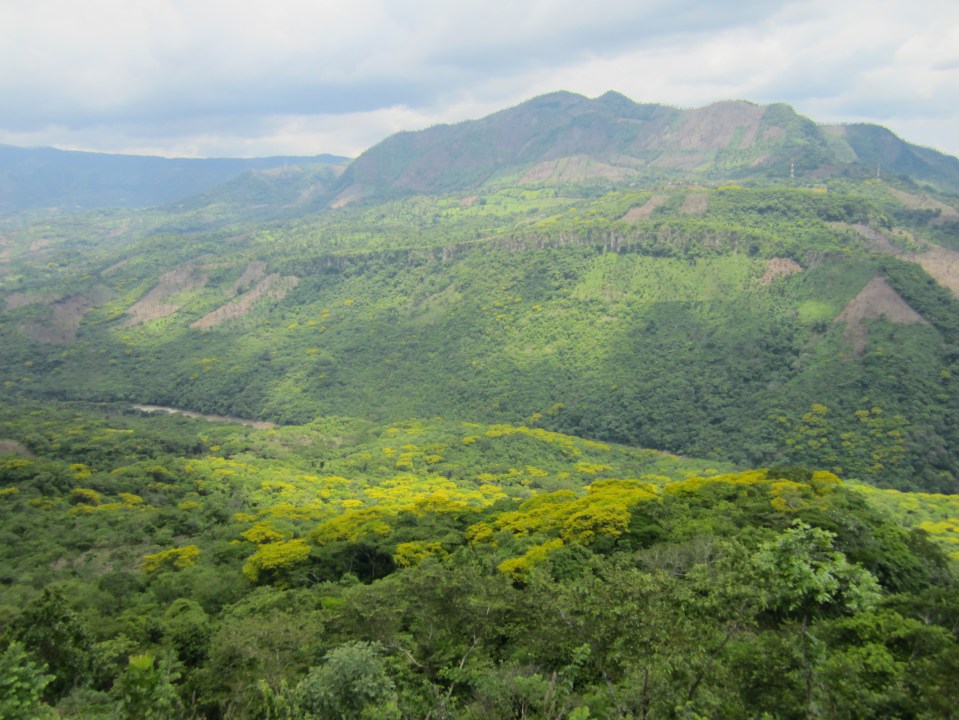
The north of Morazán, in the mountainous north-east of El Salvador is hands down the most beautiful place in the world. Yet it has one of the highest rates of migration in the country of young people seeking opportunity elsewhere. Many are in the USA, most with no legal status to be there.

Why, you would ask, would anyone in their right mind leave the most beautiful place in the world and leave family and children behind to live in the shadows in a foreign land where they are not fully welcome.

Leaving politics aside, where all positions may be justified, let us take a look at cause and effect. The north of Morazán was a free fire zone during the Salvadoran civil war, causing 100% displacement of the civilian population and complete destruction of productive infrastructure. As a volunteer during the 80s in the Colomoncagua refugee camp, across the border in Honduras, I watched the daily bombing runs of Dragonfly jets over Morazán, part of the one million dollars a day in USA military aid to El Salvador. This period marked the beginning of the migration problem, which continues today given the failure of post-war reconstruction in providing economic opportunity.

Regarding President Trump’s remark that the USA should only accept the best, I would argue that we need them here. Our brightest and best went to war in the late 70s and most were killed or maimed. They continue to leave today in search of a means to care for their families. We need to create conditions that allow the brightest and best to stay here and build Morazán into its full potential.

Morazán was not destroyed in one day. It took a decade of pounding and a lot of resources to do it. It will take some time, resources and determination to reach our goal of prosperity.

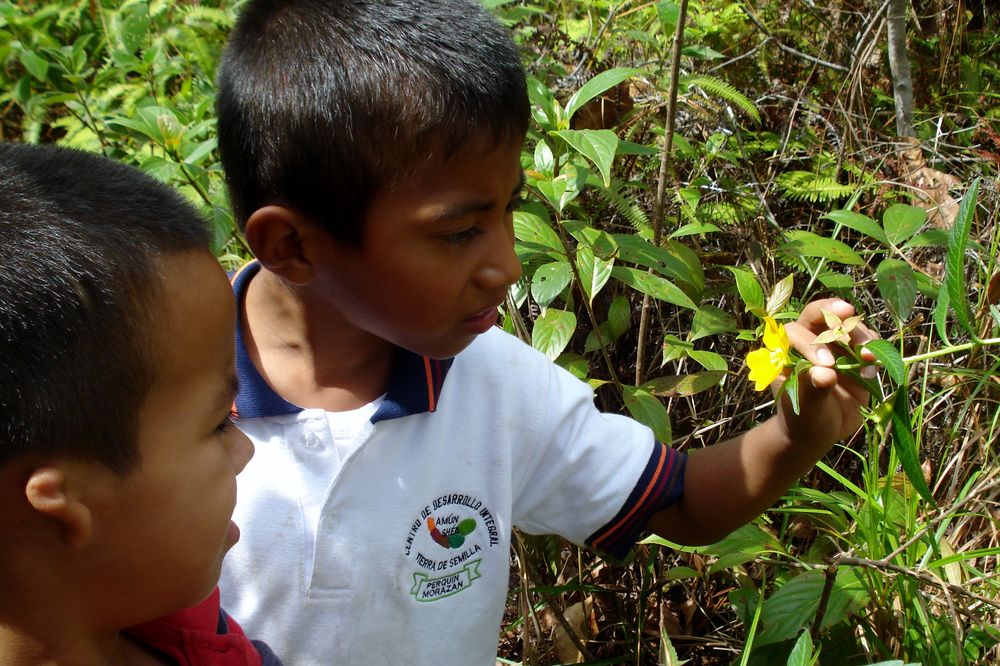
Amún Shéa is focused on assisting the creation of that reality in which  the brightest and best may prosper and thrive here at home and migration is no longer the only option. It is no magic formula and offers no quick political solution. It is an arduous task, one step at a time, one student at a time, often seemingly against the current.

Public policy is important, but if you would like to join us on the groundwork, building change from this remote territory, we would more than welcome you.

Thank you
Ron Brenneman


Building the Great Wall

There is certainly much ado regarding the construction of a wall on the border of the United States with Mexico. Known primarily as the Great Wall or Trump’s Wall, the objective is to stop undocumented movement through the southern border.

As with most politically motivated projects, this proposal has created tremendous emotional reactions, both pro and con. In an emotionally charged debate such as this, everyone on both sides of the issue is absolutely convinced they are right. The emotions of this debate are fostered by frustrated illusions on the one hand and fear of unpleasant changes of lifestyle on the other. There is little effort put forth by either side to inject a bit of objectivity into an analysis of the situation. It is within this continuing disorder that a parasitic industry of traffickers, lawyers, jailers, and unscrupulous employers rake in tremendous profits. Many special interests are involved, some representing very powerful financial pursuits and a very few working for a solution.

If the answer to the problem of controlling illegal migration is to be reduced to simply putting an obstacle in the way, that is to build a wall, it is doomed to failure from the start. Actually it would likely result in strengthening the same parasitic industry of human trafficking by provoking an increase in the fare paid for transportation as they become more creative in their methods.

If we are able to overcome the emotional part of the discussion, perhaps we can come to the same conclusion as the American poet Robert Frost, when he wrote, “Good fences make good neighbors.” That is to say we need some order in the backyard and a clear definition of the boundaries in order to avoid a constant dispute with the neighbor. Remember that a good fence serves in both directions. In looking at El Salvador and the USA, it is clear that a case may be made for mutual accusation of invasion and abuse in recent history. It is also very clear that neither party has been represented by its most favorable spokespersons in this exchange. Fear is not a good advisor to either party. In order to move forward, we must quiet emotions, identify appropriate counterparts and start dealing with this in an objective manner.

In most cases, the decision to set off on the journey to the USA is made with the perception that it is the only option to obtain a decent livelihood. It is not a decision taken lightly. Loved ones are left behind, knowing that some will never be seen again, and children are left with grandparents. The sale of land or debt incurred provides the veritable fortune demanded by the trafficking industry. This is reality for, and is the decision made daily by, dozens of men and women in villages and hamlets throughout El Salvador. We often ask how it is possible that they are willing to give up so much and to risk life itself under such adverse conditions when it is compared to the option of investing a modest amount in their own country. The answer is very simple. The confidence factor. There is little confidence that conditions in the country can actually provide a secure enough opportunity to motivate such an investment.

Following the illusion of the “American Dream” requires a high level of courage and sacrifice. It also demands resignation! This combination forges a determination that will not be interrupted by concrete walls or razor wire. To put this in perspective, most are already paying 20 times the cost of an air ticket, and in addition, are willing to risk their very essence and being on a route fraught with inconceivable dangers. Can any wall actually contain this level of determination?

The only wall feasible for containing the migratory flow from El Salvador to the United States is one that makes it more attractive to stay here than to leave. It must replace the “American Dream” with the “Salvadoran Sueño”. It must be a wall that displaces the perception of migration as the only real economic option. That is a wall built of opportunity, in El Salvador.

The foundation of this wall must be an integrated educational program that prepares the young with a proactive attitude and sense of responsibility, real life skills and opportunities for achievement. This implies a true technical-professional preparation and scientific focus in the development of a new enterprises and technologies. The wall itself must incorporate innovation, investment and open access to all technical information and productive processes. The top of this barrier must be a public policy that motivates initiative and protects local and individual economic activity from outside intervention.

So, let’s come together and build this Great Wall. Let’s create the Salvadoran Sueño that keeps our talent here through a solid program of training and opportunity and keeps your opportunists on your side of the fence.

The practical issue that comes to mind of course, is the cost. Who is going to pay for all of this? A very good question and one which deserves serious discussion. A good question to start with is, who is paying now for the disorder? The information on security and protection costs is readily available for review and is staggeringly high. As an example, in 2015 the daily cost for holding a minor in custody for illegal border entry into the USA was $252. That amount would pay a full scholarship for 45 students at Amún Shéa, a private innovative problem-based learning program in Morazan, El Salvador, which is an area of extremely high migration. Does a 45 to one ratio sound like a good investment?

Mr. Trump, you are a businessman and fully understand the difference between an investment and wasted expenditure. Let’s make a deal and work together on building a wall of education and opportunity that works for both of us. If we accept that good fences (walls) make good neighbors, then great gates may be built as well, wide open and welcoming, making us even better neighbors!

Worthwhile to Stay, or Just Harder to Get Out?

IMG_3238

New government regulations typically mean additional costs to whoever they affect .These additional costs get passed along to the customers who may fuss and protest, but in the end pay for the services anyway. Illegal immigration is no exception to the rule.

Thus, the  Obama administration’s offer to help Central American countries with security, in order to stem the flow of illegal immigration, will likely result in higher tariffs to make the trip north, but without a significant reduction in the actual numbers of travelers. It will also probably be a boom for security contractors and consultants as funding for training, equipping and supervising “counterparts” gets fast-tracked.

To be fair, we should take into account that the offer is broader. The White House Release of July 25 quotes President Obama´s remarks, “And we are committed to working together in partnership with each of these countries to find ways in which we can come up with more aggressive action plans to improve security and development and governance in these countries.” These countries, of course are Guatemala, Honduras and El Salvador. The fact that the next paragraph compares the effort to current border security programs to halt drugs running north and guns running south is rather disheartening. See the entire press release here.

“Improving security and development and governance” sounds reasonable at first glance, but seen under the shadow of experience, the offer begins with control and ends with more control. Development and other comments on opportunity are more refreshing, although the top-down transplanted system has yet to be proven fruitful.

We always come back to the solution being a long-term investment in an educational program that builds opportunity and eliminates barriers. While actually the most reasonable and simple option, the fact that it offers no short-term financial gain for vested interests, seems to make it too idealistic. Someday, not too far off, we will need to make a decision between actually following up on what we preach or continuing to serve as flag-wavers for corporate interests. A case in point is the current conditioning of aid in El Salvador to the purchase of Monsanto seeds. Just how is governance strengthened with that level of interference? Is this how we promote transparency?

The immigration issue provides the opportunity, even the motivation, to do it right this time around. The opportunity is there, ripe for picking; this is where we demonstrate our values, our principals. Are we going to help make it worthwhile staying in Central America or just harder to leave?

We have been working towards making it worthwhile at the Amún Shéa, Center for Integrated Development in El Salvador. Please consider joining in with support. Let´s do it right this time around.

The Brightest and the Best

Perquín Musings, a book I penned in 2009 contains commentary regarding immigration. Given the current focus on the subject, and the fact that we have not seen much progress on the subject during the past five years, I present the short chapter “The Brightest and the Best.”

9780988592100That is a very innovative selection process up North to get the type of foreign workers needed.

First, set up the prize. Earn as much in one hour as for a whole day in El Salvador. Second, set up the obstacle course. Practically no visas, dangerous route through Guatemala and Mexico, jump the fence and a high-risk desert run at the end. Once there, faced with illegal status and immigration roundups as the order of the day.

Maybe there ought to be a new Statue of Liberty on the Rio Grande, dividing Texas from Mexico. It would have to be updated, of course, modeled after Britney Spears or the latest iconic talent, with her belly showing. The inscription reading “give me your tired, your poor…” would also need a little updating. It should read “Give me your most daring, your fittest, those willing to take chances. Give me your initiative, your future, your brightest and best.”

With around two million Salvadorans in the States, the largest national product is the remittances they send home. In sheer numbers, that workforce probably compares pretty much with the workforce left in El Salvador.

The Darwinist selection of those who go north, however, results in a quality unbalance within the two groups, at least at the gumption level.

It is probably too early to speculate on changes to the gene pool, but we are left working with those left behind.

FlowerWe are working to slow that talent drain. El Salvador needs a few of the brighest and best to stay here at home; to change the conditions that leave migration as the only option for providing a decent living.

We do not believe in quick fixes, but that with a focused effort, change will start happening before we know it.

We are Amún Shéa and we are out to change our world. Join with us! It will change, only if we work together on this.

Politically Competent

Were political posturing and other hidden interests put aside, I wager the current immigration crisis would to a great extent just fade away. A transparent objective look at the subject also requires losing the emotional baggage instigated by the flood of Central American children to the US border.

The plight of the children is serious and cause of great concern. However, we far too often see children pushed into the spotlight as adults lose the capacity for dialogue. Indeed, throughout the world, we are increasingly resorting to using victims as a substitute for debate. Should this tendency reach the point of actually provoking victimization in order to make a point, we will have arrived at a new depth of inhumanity. Some would affirm we are already there. Aspects of the current US border crisis do suggest we have reached a threshold in that respect.

I was told by a friend a few days ago that parts of his family immigrated back during the Second World War. Apparently the shortage of industrial labor force in US factories actually provoked the need to recruit workers from south of the border.

No expert on immigration, I am not clear of how the situation evolved over the years. What is perfectly clear is that, in spite of current legality issues and physical obstacles, everyone who gets through gets a job. One can only assume the existence of a real job market.

As to the reason behind not recognizing that demand or need, we would need to enter into the shadowland of interests, greed and political maneuvering. The “illegality status” creates an underworld of parallel, unregulated and highly profitable financial and commercial structures.

It also creates family rupture as parents cannot freely travel back home and periodically see their children. This is one of the main contributing factors to the current child immigration situation, in my opinion. I know people in this situation. They went to the USA for the employment opportunity and as the means of providing for their families. They had no intention of staying on, but the economy got tough so it is taking longer than originally planned. They are worried about their children, with all the bad news coming out and they are being forced to make the decision to stay or leave. Staying means bringing in the family.

Canada takes a different approach. Employment opportunities, complete with strict requirements, are published by the embassy. Recruitment, selection and work visas are coordinated through diplomatic channels. Employees travel by air, just like the rest of us. They enjoy vacation periods and are able to visit home periodically. Quite the contrast…

So, why is it that we cannot publically acknowledge what we actually are doing; what we actually need? Cannot we understand that the “out of sight, out of mind” attitude comes with a pricetag; we only favor dark interests when we refuse to see reality. It also opens us up to be manipulated and that generally is brought to bear on our emotions. The “plight of the children” is in fact very real. But have we had a part in creating the crisis because we refuse to respond to any other stimulus?

How much control have we given away, in exchange for not being bothered? Have we noticed how Politically Correct gets twisted into Politically Convenient? Perhaps we need to ask ourselves whether we are actually Politically Competent. Perhaps all of us, on both sides of the border, need to take back some control and responsibility… and leave the kids alone.

Mixed Messages

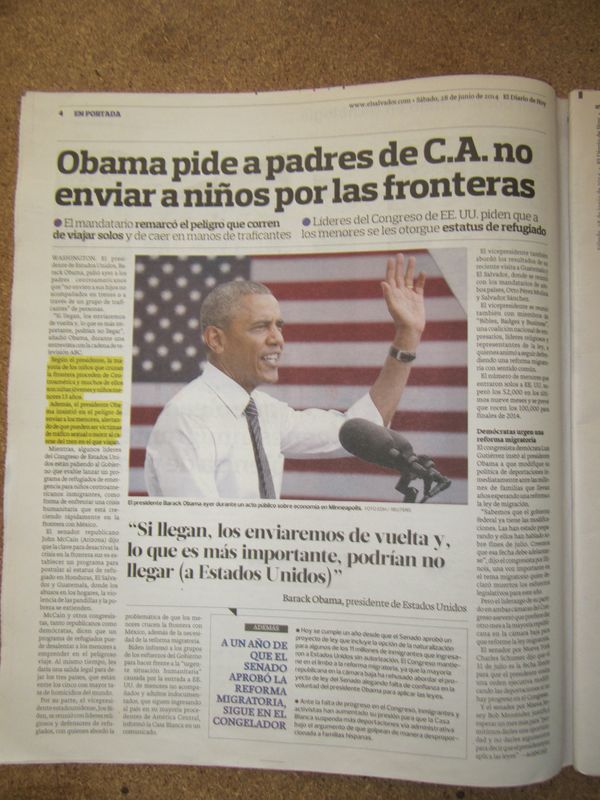
Obama asks Central American parents to not put their children at risk.

Obama asks Central American parents to not put their children at risk.

The local paper reported earlier this week that the trip to the US border is now done in an express five days, as opposed to the normal two weeks of peril and danger. An official and very stern message came out from the US just days ago, that children with at least one parent in their home country would be deported. News filters back each day of the ease the crossing has become.

The child immigration issue remains highly volatile and extremely politically charged. As such, the messages are quite the mix; the sternest warning always allowing exceptions. The message received and understood here is the exception part; we are after all Masters of Exception.

While true that there is too little information to call it conspiracy, there are too many coincidences to call it chance. Let us take a look at the perception here on the ground, in small communities off the beaten path.

Migration is restricted from deporting children detained at the US border.

Migration is restricted from deporting children detained at the US border.

Several weeks ago, the news spread through the grapevine that the USA was opening the border for children. Some sources actually put the number at 70,000. The beginning source of the news seems to be the “coyotes” who earn their livelihood by guiding immigrates north. It must be understood that the local perception of a “coyote” is not that of the negative “human trafficker” that is generally portrayed by official sources. Coyotes are often members of the community who have built up their reputation by providing this transportation service to their neighbors for generations.

The recent flood to the border did in effect open the gates. Normal procedures were set aside and new arrivals were just deposited at bus stations. Word got back very quickly and the flood north gained strength.

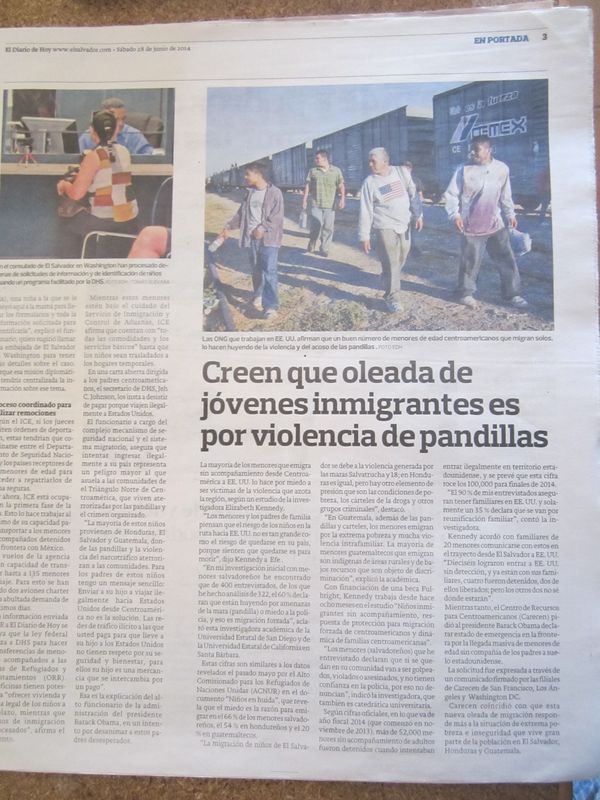
It is believed that the wave of young immigrants is due gang violence

It is believed that the wave of young immigrants is due gang violence

The trip north normally takes several weeks, as the coyote times segments of the journey with work shifts of collaborators and with negotiation for passage through territories held by differing, often conflicting organizations. The word is out now that the obstacles have been removed; coyotes are able to double the number of trips per month as it is now possible to arrive in just 5 days.

The “do not send your children or they will be deported” message, conditioned by “if they have a parent in the home country” is an invitation to keep coming. Most of the younger ones are going to be with their one parent or parents who are already in the USA. They are leaving grandmothers and aunts, very few are leaving parents.

"If they arrive, we will send them back..."

“If they arrive, we will send them back…”


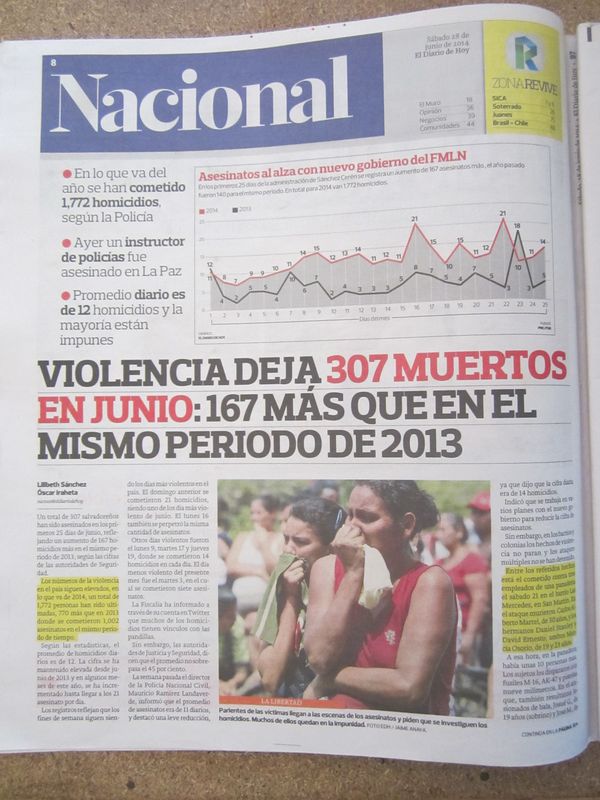
Today´s paper, El Diario de Hoy, is a perfect example.
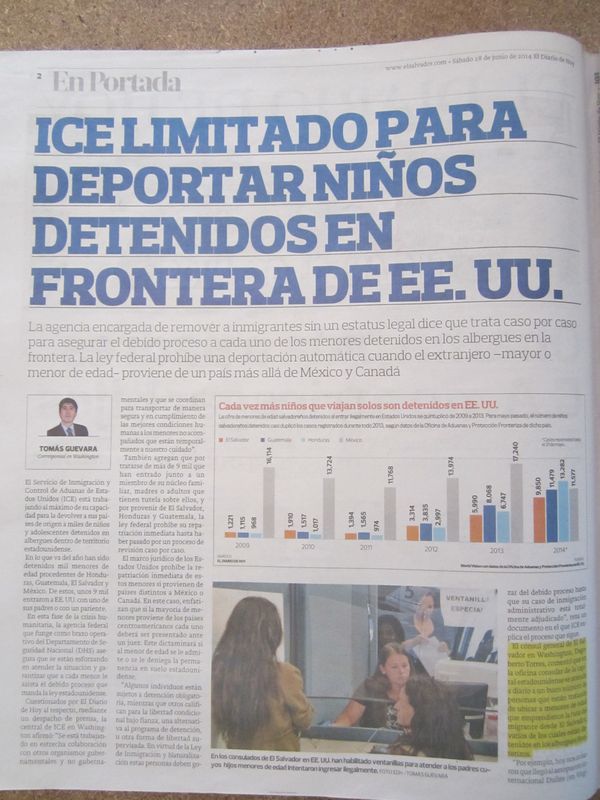
The headline reads “Obama asks parents in Central America to not put their children at risk.” Pages 2 and 3 detail the fact that children from Central America cannot be deported without a long process. Page 3 cites a study concluding that the immigration is due gang violence. Page 4 is the article from the headline citing President Obama´s message to Central American parents. Page 8 uses red ink to showcase the 307 violent deaths in June for El Salvador, 167 more than last year.

Violence leaves 307 deaths in June: 167 more than the sme period last year.

Violence leaves 307 deaths in June: 167 more than the sme period last year.


Put yourself in the place of a Central American parent, for a moment. You have been in, let´s say, Houston for six years and have a decent job which allows you to send support back to your family. You left your daughter behind, with your mother, when she was just four years old. Now she is ten, you haven´t seen her or watched her grow and you are starting to worry for her wellbeing. You´ve heard the rumors, seen the news and know of friends who now have their children safely with them.

What would you do, right now?

Too Big to Solve

IMG_2816

As a happening that could be interpreted as deliberate, the flooding of the southern USA border with children from Central America has jolted the immigration reform debate. It has also caused a flare-up of fear and insecurity for some people. The human rights aspect, always a factor in the reception and treatment of immigrants, especially those considered illegal, has become a major issue due to the drastic increase in “unaccompanied” children turning themselves in to US Immigration officials at the border.

All in all, an already unwieldy problem just warped into a complexity that borders on too big to solve. Many components contribute to the problem and fingers are somewhat justifiable pointed in all directions as human interest and unfortunately self-interest comes into play. While there are many facets to explore, today we will take a look at just one: The Money Trail.

“Who is paying for all of this?” is a very understandable question, especially in today´s economy where just making ends meet could be considered quite the accomplishment. So, let´s take a look at the immigration economic impact, not from a national aspect because spending has never been a problem for a nation, but from the angle of the groups benefitting financially from what we must accept, is a Growth Industry.

To understand the idea of a growth industry we must look at this issue within the larger context of the US Prison Industry. According to published reports, US prisons have become a very lucrative endeavor, since components of the system were privatized. Resources are invested to insure they are operated at maximum capacity, as with any other business, and the effect is that the overall prison population has gone from 300,000 in the seventies to over 2 million today. According to Prison Policy Initiative  over 50,000 of that number is represented by Immigration offenses and detention. At a reported $20-$33,000 a year per inmate, the “who is paying for this” question just made a substantial dimensional leap. Add to that the bail bond and parole businesses and you have a real industry that is managing serious numbers.

I just talked with a Salvadoran friend in the USA regarding this aspect of entering illegally. It really comes down to a matter of survival and those who cannot make the desert run turn themselves in. Normally they will be given a date to appear at court and be released on bail. Many will forfeit that bail. “You end up working for the courts your first year here,” I was told. It is also important to keep in mind that the costs involved do not fall solely on the US Border program. The immigrants themselves and/or their families have made an important financial investment just to gain entry.

To fully understand the cost for the immigrant, we must incorporate the economy of their home country. Most are leaving rural areas that offer no employment opportunity. The necessity of surviving on less than one dollar a day is widely used as the benchmark for extreme poverty in Central America. Minimum wage in El Salvador for commerce and services is $8.08 per day or $242.40 per month, less social security and pension for a take-home pay of $ 219.99 ($7.33 per day.) Agriculture salaries start at $3.50 per day.

Currently the cost, from where we are in eastern El Salvador to the US border is from $4,000 to $9,000. This is paid to the “coyote,” the local guide with all the connections to deliver you to the border. One thousand of this goes to the Zeta Drug Cartel for “safe passage” through their territory. This safe passage is no guarantee at any step of the two-week journey. Immigrants face robbery, extortion, beatings, rape and kidnapping into the sex trade. Once at the border, and opting out of the desert run, you turn yourself in and start looking for help to pay the bail bond, which I understand runs between $1,500 to $10,000. This latest border overload has caused a boom in the attorney business, which offers to get you through for another $3,000.

If you consider the number of immigrants and the cost figures mentioned, the dollar volume is staggering; In short, too much money is involved to allow a solution.

Causes me to ponder with regard to where people put their hopes and trust. Creating the conditions in which one could be confident of investing at home rather than risking life, limb and a huge debt to gamble on getting into the USA, needs to be our goal.