Category Archives: Education

Perdiendo el control

Una simple búsqueda en Internet de la frase “métodos alternativos de educación” arroja más de 2,5 millones de recursos en algo menos de medio segundo. “Los problemas en el sistema educativo” registra unos 13,5 millones en menos tiempo. Aquí estoy a punto de añadir otro recurso más a la discusión.

He llegado a la conclusión de que en estos temas vamos a seguir patinando mientras no lleguemos a tratar el punto central de “control”. ¿Quién controla la educación? ¿Para que finalidad?

Poniendo el control total del aprendizaje en las manos de los estudiantes estaríamos mucho mejor. Las instituciones educativas debieran limitarse a proporcionarles infraestructura, herramientas y orientación, dejando el diseño del “programa” en las manos de cada estudiante. Así, cada uno podría seleccionar las combinaciones y configuraciones más adecuadas para trazar y realizar su propio plan de vida.

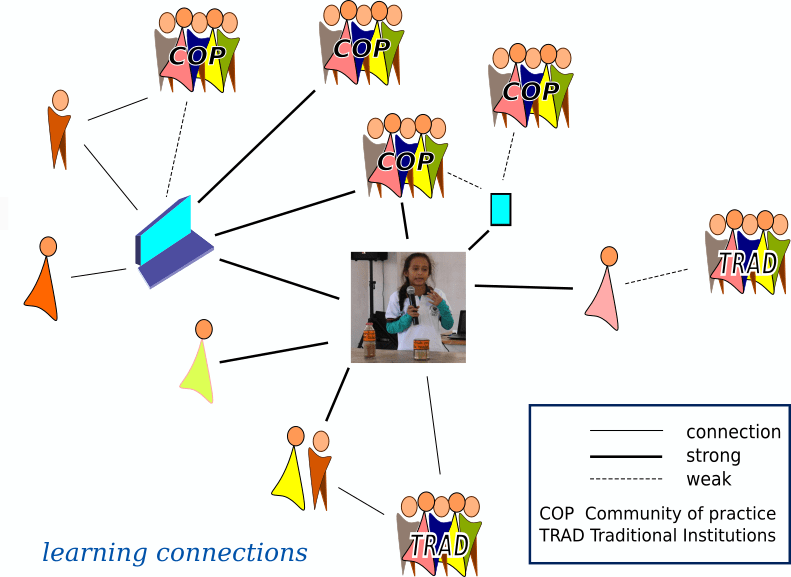
Hay que botar el anticuado modelo industrializado de educación basado en contenidos. No hace falta reformarlo, sino botarlo. Necesitamos acercarnos a lo expresado por Terry Shaneyfelt en su artículo titulado “COP, PLN, y Conectivismo: Una expresión creativa” donde sugiere que el aprendizaje sea el resultado de una combinación de herramientas digitales (PLN) y comunidades de práctica (COP). Las COP deben entenderse como la unión voluntaria de un número de personas en torno a un interés compartido.

Todas las herramientas necesarias para permitir el aprendizaje individualizado ya existen. No hay excusas, sólo miedo. El miedo a perder el control.

Tenemos que perder el control, entregar la responsabilidad al interesado y confiar en que este se desarrollará con verdadero progreso. Y de hecho, también escribir menos sobre estas cosas y poner nuestras propuestas en práctica.

La pobreza como una identidad cultural

Desarrollar un programa educativo dentro de un área marcada por la pobreza tiene complicaciones. A medida que se adquiere experiencia, la visión de que la educación realmente puede causar una mejora en las condiciones socioeconómicas locales se convierte en una brumosa comprensión de las condiciones que crean y, más importante aún, reproducen la pobreza.

Al iniciar la escuela Amún Shéa en Morazán hace ocho años, en el noreste de El Salvador, sostuve la idea de que las condiciones socioeconómicas bajas eran de carácter técnico, que podrían mejorarse a través de la formación de las personas para que asuman la tarea del desarrollo. Mantengo todavía la idea que la solución está en la educación y la formación del individuo. Lo que ha cambiado mucho es mi entendimiento de la naturaleza de la pobreza.

Cuando la frase “somos pobres” se afirma en las personas como una condición permanente, como a menudo se escucha por aquí, es evidente que la pobreza se ha convertido en parte de la identidad cultural. Como tal, la sociedad toma medidas para proteger y reproducir esa herencia. El miedo al cambio es la norma y la demonización de los que rompen con el status quo es el medio para reforzarlo.

En muchos niveles y entornos la pobreza es recompensada y el progreso castigado. Lo que he observado en la educación es que una vez que los estudiantes alcanzan un cierto nivel, el entorno deja de estimularles a seguir adelante. Esto ocurre típicamente en los grados séptimo y octavo cuando los estudiantes alcanzan y comienzan a superar la madurez emocional y también el promedio de escolaridad de la sociedad en general incluyendo, en muchos casos la de sus padres y profesores. Estos jóvenes suelen ser percibidos como una amenaza a medida que desarrollan el pensamiento crítico, la madurez emocional y la capacidad técnica por encima de la norma establecida.

Este fenómeno es parte de un miedo inherente de perder el control, impulsado por sentimientos de insuficiencia y baja autoestima. Esto significa que para acelerar el cambio socioeconómico positivo y la mejora necesaria de las habilidades técnicas y académicas de nuestros estudiantes es necesario atender las necesidades emocionales de los adultos, al menos de los que participan en la comunidad educativa.

Afortunadamente, hay excepciones dentro de las comunidades locales. La Fundación Perquín para el Fomento de Oportunidades Educativas (PEOF) está trabajando un innovador programa educativo que tiene la visión de proporcionar las herramientas para el aprendizaje directamente a los estudiantes. Al mismo tiempo, estamos trabajando para lograr la incorporación de una atención focalizada dirigida a profesores, padres y madres como componente permanente en el programa educativo.

No estamos solos en eso. Fue una sorpresa agradable encontrar intereses comunes y una visión compartida dentro de un segmento importante en el Ministerio de Educación Salvadoreño (MINED). Esto nos llevó establecer un programa para padres y profesores como una directriz principal en el convenio “Piloto para Educación Rural Relevante” firmado entre PEOF y el MINED.

Cuando la educación asume la tarea de cambio socioeconómico, el enfoque se amplía desde el cuerpo estudiantil hacia toda la comunidad, partiendo del punto de vista técnico, hasta incluir los problemas sociales y emocionales que se han incrustado en el mismo tejido cultural. Este reto es mayor que el que nos planteamos hace ocho años, pero por ello mismo es necesario que sigamos adelante.

Poverty as a cultural identity

Developing an educational program within an area scarred by poverty can get complicated. As experience builds, the vision that education can actually cause an improvement in local socioeconomic conditions has evolved, from being a given and straightforward process into the quagmire of understanding conditions that create, and even more importantly, reproduce poverty.

When starting Amún Shéa school in Morazán, in northeast El Salvador, eight years ago, I held the notion that the chronically low socioeconomic conditions were of a technical nature, which could be improved through the formation of individuals to take on the task of development. I still hold that the solution lies in education and formation of the individual. What has greatly changed in my understanding is the nature of poverty.

The verb “to be” in Spanish has two conditions: one of a temporary nature (I am hungry) and another of a permanent nature (I am from Delaware). When the phrase “we are poor” is stated in the permanent condition, as often heard here, it is clear that poverty has become part of the cultural identity. As such, society actually takes measures to protect and replicate that heritage. Fear of change is the norm and demonization of those who break with status quo is the means by which this is reinforced.

It is notable the extent to which poverty is rewarded and progress punished on many levels and in many settings. What I have observed in education is that once students reach a certain level, they are no longer encouraged to seek personal development. This typically happens in the seventh and eighth grades as students reach and begin to surpass the emotional maturity and academic capacity of local society in general, including in many cases that of their parents and teachers. Clearly these young people are perceived as a threat as they develop critical thinking, emotional maturity and technical capacity above and beyond the established norm.

This phenomenon is part of what I see as an inherent fear of losing control, fostered by feelings of inadequacy and low self-esteem. It leads me to the conclusion that in order to expedite positive socioeconomic change and for the needed improvement in technical and academic skills in our students, we must deal simultaneously with the emotional needs of adults, at least those involved in the educational community.

Thankfully, there are exceptions within the local communities. It is this group with which we as Perkin Educational Opportunities Foundation(PEOF) are building a solid innovative educational program with the vision of providing the tools for learning directly to the students. At the same time we are working towards incorporating a focused attention directed towards teachers and parents, into the educational program.

We are not alone with this issue. It was a pleasant surprise to find shared concerns and vision within an important segment in the Salvadoran Ministry of Education (MINED). This led to  is establishing a program for parents and teachers as a prime directive in the technical agreement “Pilot for Relevant Rural Education” PEOF signed recently with MINED.

When education takes on the task of socioeconomic change, the focus broadens from the student body to the entire community and from the technical angle to include those social and emotional issues which have embedded themselves into the very fabric of the culture. Much more than I planned on dealing with eight years ago, but then even more crucial to follow through.

Learning Connections

Taking up the invitation put forth by Terry Shaneyfelt, in his blog COPs, PLN, and Connectivism: A Creative Expression, I was inspired to play around with the concept as a way of better explaining my thoughts on education. I did have to play around with my software as well, given I recently evolved to Linux; learning is fun, I love it! So, here goes:

cop-svg

In applying connectivism to our school setting in Amún Shéa, we need to add the influence of traditional institutions. This includes the Ministry of Education, the community as a whole, church and other institutions which hold sway over the domain. While by no means tagging tradition with negative influence, it may be held that these institutions generally tend to move along towards change at a fairly slow pace.

What does become clear is the role digital tools play in the creation of Communities of Practice that transcend physical location and allow the grouping of people around the world based on passions and interest.

The challenge perhaps resides in converting the TRADs into COPs, as well.

A proposal for education from Morazán

IMG_7357For the purpose of contributing to a sustained discussion regarding the state of education in El Salvador, I would like to make a concrete proposal. My proposal is based on seven years of experience with the Amún Shéa Center for Integrated Development, in northern Morazán.

Amún Shéa is a proven educational option existing in El Salvador, Central America and is one of many that exist around the globe.

In a world with such diversity it becomes necessary to question whether the uniformity sought by a national education program is valid today. My premise is that the pace of learning, as well as interest and motivation, has a highly individualistic component, and is very unlikely to be fully developed through curricular and methodological standardization.

My proposal is aimed toward “liberation of education.” To do this academic standards are raised and pathways to learning are expanded, clearly establishing the goal of education and assessment requirements, but leaving freedom of choice for the individual regarding the route to reaching that goal.

It would also require establishing a committee or group of experts detached from the educational institutions themselves. Following the criterion of a separation between judge and jury, this commission would independently define standardized criteria of excellence, setting clear goals for each specialty and establishing mechanisms to evaluate those aspiring to graduate.

Currently schools and universities bestow titles and diplomas on their own students, with a variety of criterion and often with dubious results. With this new procedure, the effectiveness or validity of a center or education program would be determined only by the quality of graduate it produces, leaving behind the superfluous discussion on approaches, practices or the role of teachers.

In addition to technical and academic skills, educational goals would respond with a beneficial individual molding of citizens capable of bringing El Salvador out of its backwardness and current state of violence. I do not propose replacing the public system, but to enrich it with agile and independent alternatives, more adaptable to local needs and opportunities.

Educational liberation, as I see it, is the easing of curricular and methodological uniformity and bureaucratic obstacles that do not directly contribute to the learning process. In this scenario, government would focus on encouraging and supporting alternative programs that respond to the diversity of interests and passions of the student population, as well as meeting the genuine demand for local skilled labor and technical and professional skills.

Far from being an idealistic approach, this proposal responds to the reality of an unequal distribution of resources and opportunities based on geography and the social background of students. By contrast, the traditional education system is “idealistic” in that it assumes equality throughout the country that, despite being small in territory, is highly diverse. If we can free ourselves from rigid strategies we could level the playing field for all players. We have found that in the absence of resources, creative solutions to problems tend to blossom and thrive.

Those of us from the Pink Floyd generation remember that their classic “Another Brick in the Wall” invited us to change the world. The challenge was not limited to changing the color of the bricks or replacing them with a different material, but to deliver us once and for all from the enslaving uniformity that dominates the current notion of education.

————————

This blog appeared first as a article in spanish in the Jan. 20 edition of the Prensa Grafica in El Salvador. Go here to see the original article.

Changing Attitudes, a major challenge for Development and Education

BW Attitude

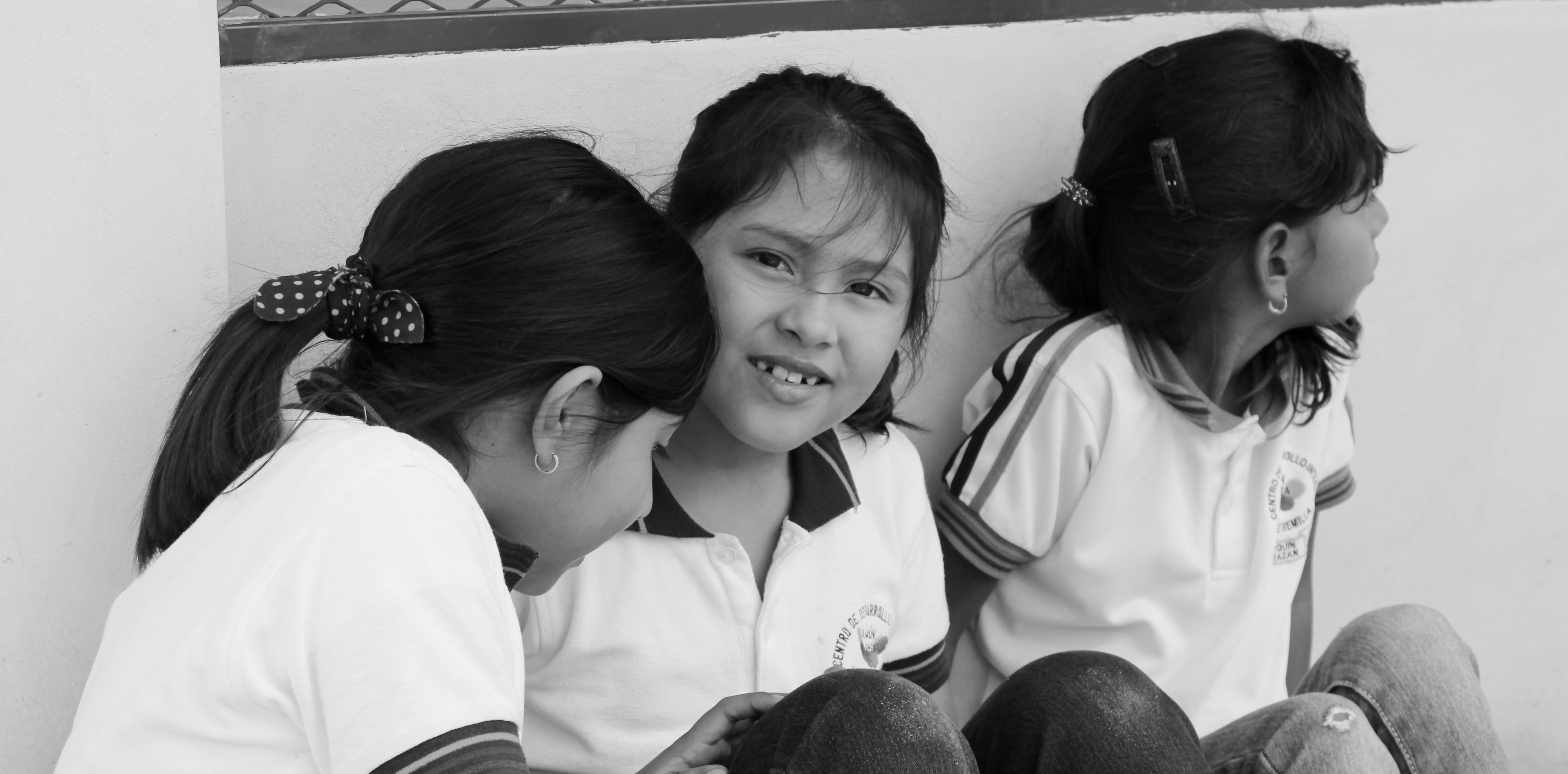
At Amún Shéa, we are enjoying a substantial degree of success using critical thinking, analysis and debate on relevant issues as tools to foster positive can-do attitudes. Our current challenge in this component is to instill a sense of social responsibility, intrinsic motivation and self-discipline in each student. This is easily the least understood aspect of the program within the educational community and requires considerable tact in its presentation. Empowerment of students sounds enlightening, but the shift in control that occurs when it is actually carried out (and not just spoken of) triggers an incredible resistance.

We have a formal educational community organization consisting of representation from the student council, the teachers’ commission, the parents’ organization, school administration and the Foundation. It is fascinating to observe the chemistry between these groups as we work towards shared decision making. Discipline is the “elephant in the room” theme brought up each time an adult feels pressured by this process. The discipline conversation always directs our attention to an idealistic and more ordered past where social structure seemingly had greater definition, and appearance revealed worth.

Perhaps the uncertainty of the world today causes one to yearn for a simpler, less complicated period. The vision of impeccably uniformed students with greased-back hair, toes pinched in freshly polished shoes and creases you could cut cheese on, mothers pretending they love getting up at four in the morning to produce such a fine specimen and fathers over in the shade nodding their approval, brings to mind a safe haven in the past. Perhaps a reluctance to accept the inevitable changes that children push for, a reluctance to abandon status quo, creates this yearning for “The way it used to be.”

This “safe haven” period generally refers to the industrial age educational system. The world moves on however, and humanity evolves. We have entered into a new age, not yet fully defined perhaps, but marked by what can only be defined as dimensional or evolutionary changes. Either by design, choice or by chance, the past is relevant only as a lesson and a reference point as we move forward. New definitions as well as fresh norms of social conduct are necessary in order to navigate ever-changing currents, hurdles and opportunities in our increasingly complex world.

Strict obedience to authority is absolutely necessary in many minds, and there within lies a major problem in changing attitudes. Our position is that the final product of strict obedience is dependence, which is fine if your objective is to create soldiers and employees for the industrial age, but which does nothing to jump-start new socioeconomic growth. Genuine progress demands out-of-the-box thinkers, independent and skeptical of external approval, willing to take risks and with a high degree of both ability and self-confidence. We must understand that the phrase, “Because I am in charge,” is a direct affront to this process.

Observation leads me to contemplate the extent to which our thinking processes are evolving. Not all of the differences of opinion and position may be attributed to adolescence and generational “growing pains.” Without overstepping my area of experience, I believe we need to take a good look at decision making processes and the impact that honor codes have on that process. I would hazard a guess that those who yearn for the “safe haven” past maintain a strict code of honor which firmly establishes right and wrong within their understanding. An evolutionary process manifesting itself in many younger people seems to be that of developing a decision making process of comprehensive assessment unique to each situation; flexibility.

Care must be taken that our attempt to promote acceptable social behavior among our youth, through codes of honor, does not actually condition them to accept superficial codes. Codes which are imposed and not naturally assimilated are easily exchanged for another. While strict ethical codes are pictured as noble, there are many sectors of society which operate with authoritarian codes that accept no questioning; criminal organizations, youth gangs and cults, to name a few. We would be much further ahead by accepting that both evolution and our youth are moving in the right direction and support them in this transition.

Caught in transition between the industrial/information age and the incoming yet-to-be-named eon, we need to structure our programs with flexibility that bridges rather than breaks down community during this period. A level of tension, both generational and from a difference in vision will be prevalent, even volatile at times. We must learn how to responsibly manage those differences and understand the processes provoking those them.

It is clear that changing attitudes is a long-term endeavor, in all probability involving several generations. The length of the process should not be seen as a problem, insomuch as we have a comprehensive strategy and are moving daily in the right direction.

Integrating Education and Development

Garden Results

Northern Morazán is a remote border region in El Salvador. It is an area where the dimensional divide between education and development is very clearly demonstrated. Hundreds of local young people graduate from “vocational school” each year and enter “the real world” without the basic skills needed to face daily obstacles and to seize the occasional opportunities when presented.

High school in El Salvador has both a two-year general program as the route to university studies and a three year vocational option. Most rural students opt for vocational studies, as they lack the financial resources involved not only for tuition but for travel, lodging and living expenses to go to university. The problem is that most rural high schools have only one, and at the most two, vocational options. The high school in Perquín, Morazán provides Accounting and Secretary as the two vocational options, from which over one hundred students graduate each year. The obvious contradiction is that northern Morazán, statically the poorest area in El Salvador has little to no openings for these positions. The other difficulty is that the educational curriculum for these specialties is outdated, requiring the graduate who does find employment to relearn their skills once again.

Actually, a vanguard educational system should be the most significant means available to lead development and fight poverty in remote areas of developing countries. However, the traditional separation of formal education from socioeconomic developmental programs results with both falling far short of essential expectations and having little impact on real living conditions. It is indeed a sad truth that expectations regarding both program areas have plummeted, as the status quo of helplessness reigns supreme.

Attempts to effect change are often viewed as unrealistic and discarded as impractical theories. Programs too often are funded only because tradition and political correctness mandates tolerating this social burden, even though the probability of failure can easily be assumed.

Both, may we say, industries, have become institutionalized and increasingly specialized, conceivably to their own detriment. There is an obvious flaw in educational programs that are focused on forming excellent employees but work within a reality of very few job opportunities. Equally, developmental programs often mistakenly assume that the beneficiary population has sufficient knowledge or has the capacity to assimilate new techniques and productive innovations, creating frustration and inefficiency during program implementation and operation.

Very often these educational and developmental programs operate side by side without ever coming into contact with each other. Ostensibly they are all inclusive and mutually exclusive. Unfortunately, neither has managed to solve the social or economic woes in rural areas of developing countries. Both focus on content, knowledge, tools, resources and projected outcome. It is striking that neither consider attitude, self-motivation and self-realization to be basic components in their strategic planning and methodology.

A credible study of the long history of charity programs, reconstruction projects and readily available technical training courses will reveal a high degree of passivity and dependence on outside intervention as a direct result of their implementation. Development projects actually become a means of subsistence in and of themselves without hope of actually originating self-perpetuating productiveness and sustainability. The projects themselves become the employer and the organizations are often converted into a type of family business. Within this setting, traditional education has no clear purpose and therefore offers very little beyond simply keeping the children occupied while parents are working. It could essentially be said that these areas are primary components (purposely or not) of the Poverty Industry, in that “Education” provides the beneficiaries for continuous “Development” which maintains the demand for perpetual assistance and expert intervention.

Constructive socioeconomic change requires integrating the technical capacity focus of development with motivation or positive change in attitudes which are developed through appropriate educational methodology. This implies bringing the two programs together in a way that will enhance both. It requires providing education with a purpose for its existence. It means channeling development through those with interest, willingness and the capacity to assimilate innovative programs. It will provide a support structure to development and coverts education into a relevant, meaningful activity.

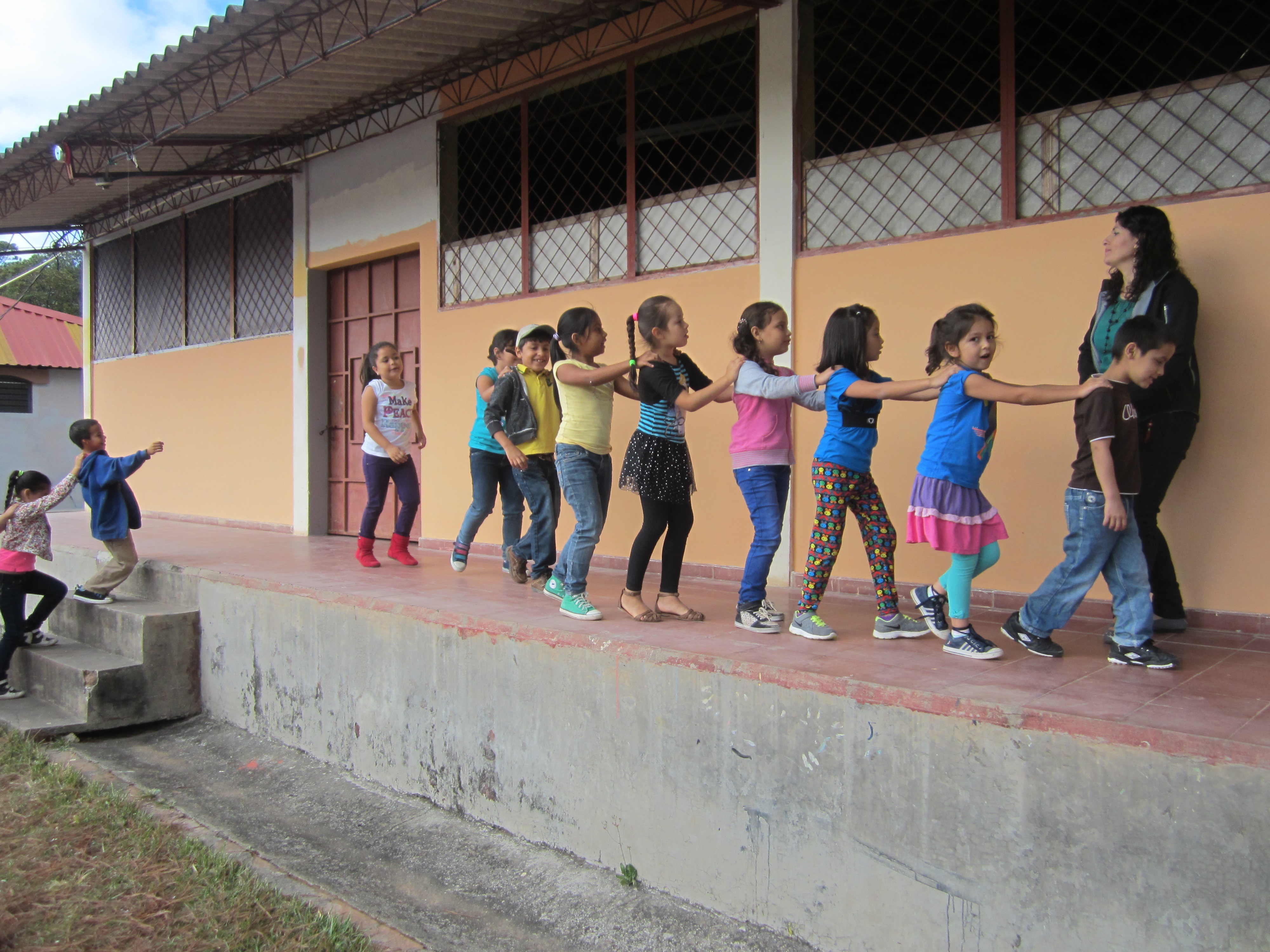
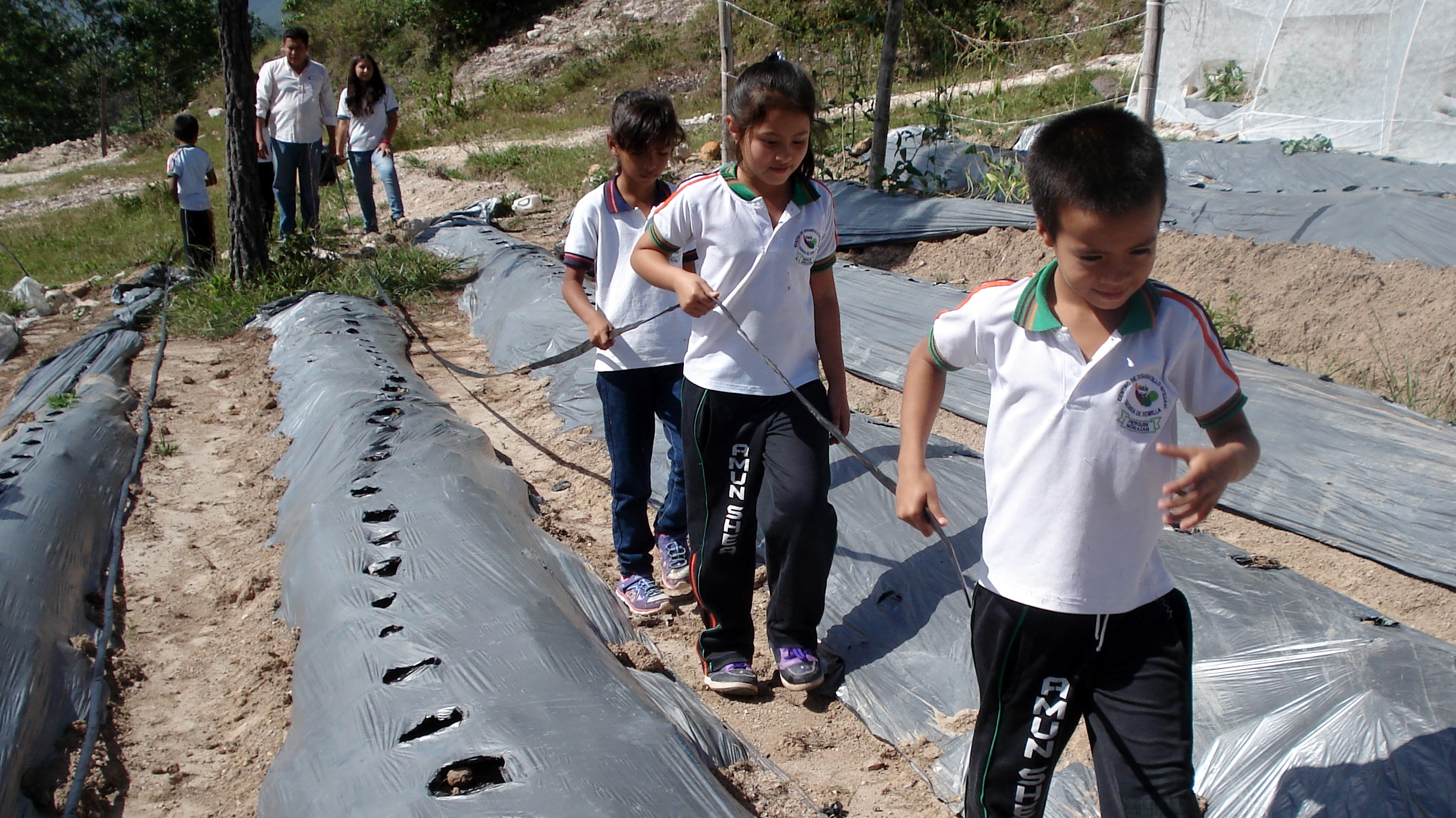
Amún Shéa, Center for Integrated Development in Perquín, Morazán is an example of the needed integration, with a curriculum that strives to bridge the dimensional split between academics and development. This is done with hands-on participation by the students in building solutions to local developmental hurdles. Beginning in 2008 with kindergarten through third grade, the program has expanded one grade per year, reaching ninth grade this year (2014.) Accreditation for High School next year is in process with the Salvadoran Educational Ministry.

Amún Shéa stands out from the Salvadoran norm in several concrete ways. The Amún Shéa program runs from 7:30 am to 3:00 pm, practically doubling the half-day public education system. Whereas the methodology in the public system is limited to the teacher copying material from a textbook to the chalkboard (whiteboard now, in some cases) and the student copying that same information into their notebook, our problem-based methodology integrates current and developmental concerns into the subject matter.

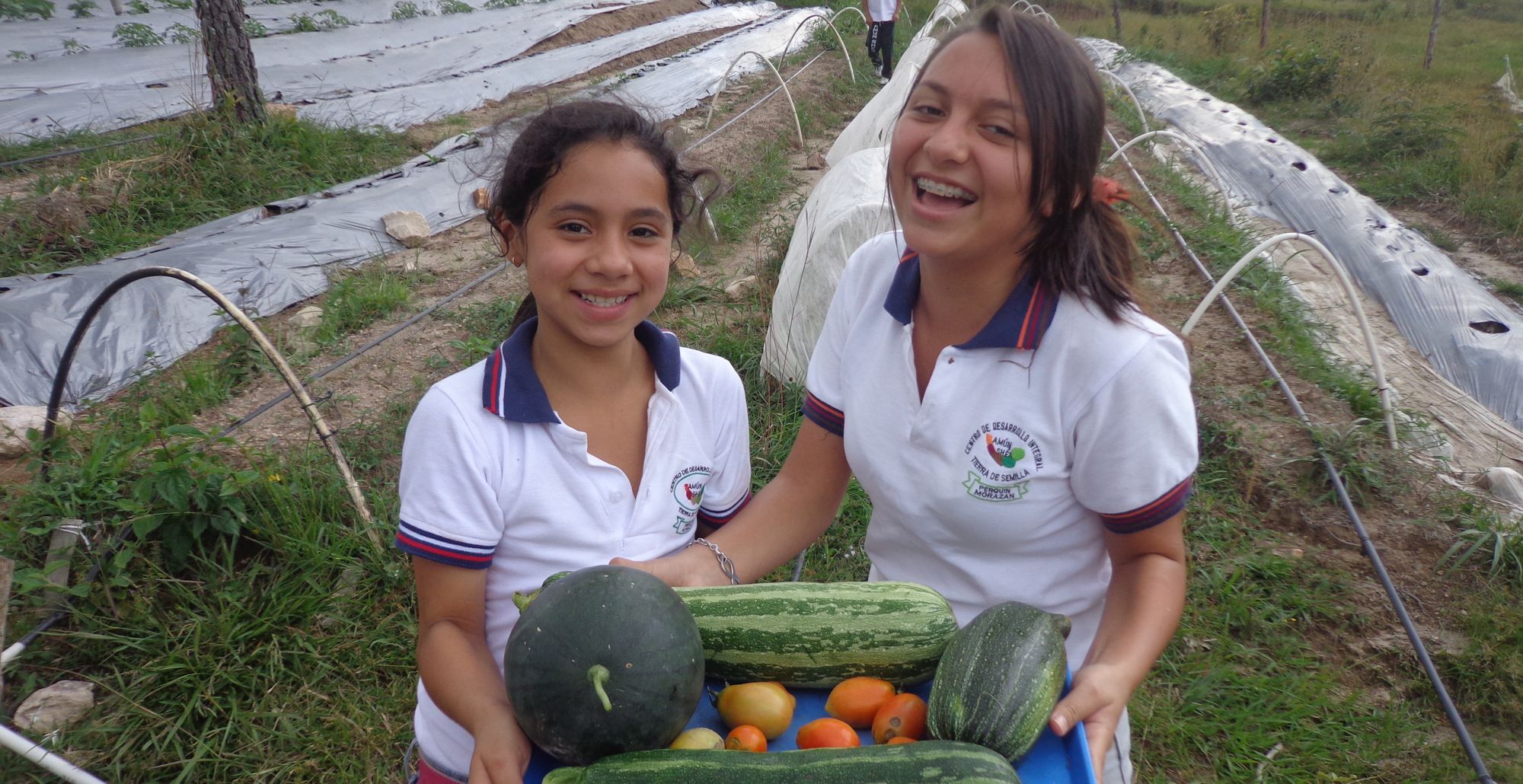
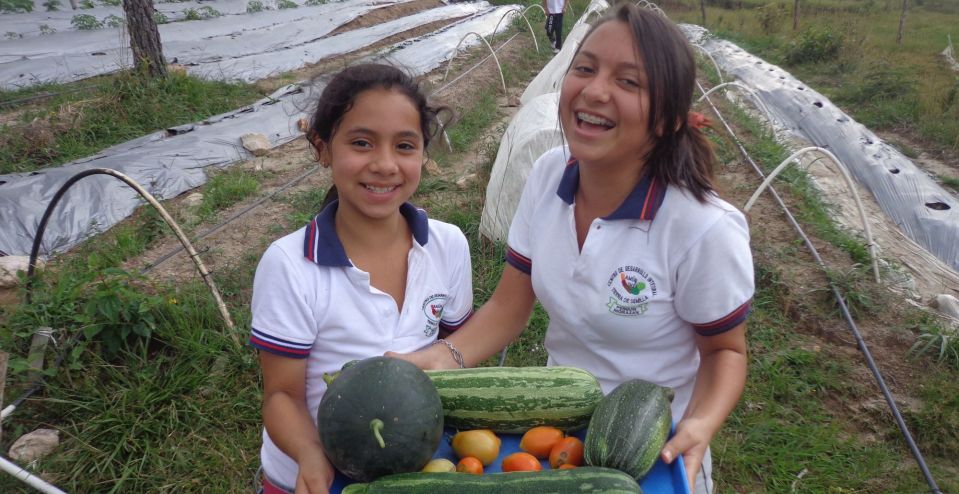
As the school runs a full day and nutritional-related health deficiencies within the area are alarming, Amún Shéa incorporates a complete nutrition program which provides nourishing meals, nutrition training, cooking lessons, vegetable farming, fishing farming and hygiene training. Coordinated with the USA-based organization GlobeMed, the objective of the program is to go beyond providing the daily snack and lunch to each student to actually modifying eating habits and diet within the community, beginning with the families of the students. As well, this activity opens the opportunity for families to learn from the program and implement vegetable gardening and fish farming as a business enterprise, which helps broaden the local production base from subsistence basic grains.

Amún Shéa students take on real-world problems for their scientific investigation projects. In one case, the sixth grade investigated the local municipal water supply after experiencing firsthand in their homes the indication of contamination within the distribution system. They traveled to the water source of the system, high in the neighboring Honduran mountains, interviewed the inhabitants living around the source and inspected the source. They then inspected the filtration plant, tanks and distribution system. They uncovered lapses and gaps of responsibility between the municipality and local health authorities. In the end, their investigation forced improvements in the water system for over 3,000 people.

Creation of business plans is another exercise for the integration of real-world situations into the subject material. Several small enterprises have germinated from this process, as parents are convinced of the viability by their child´s work.

Cultural research and investigation as a means of building community and personal identity is an elemental part of the program. Collecting testimony from senior citizens regarding past events, practices and local history, researching local legends and lore, and searching out traces of indigenous roots all assist in personal orientation. In this aspect, not only the past is covered, but current tendencies as well, including immigration, economic activities and opinion polls.

Each student is equipped with a Personal Learning Environment, basically the digital tool-kit and portfolio they will use and further develop throughout their lives. This emphasis on digital tools and resources actually levels the playing field for our students, giving them access to the same information and processes as students in more favorable conditions. It also compensates for the lack of locally available information in needed areas of technical study.

Integration of education and development is the key to initiating positive socioeconomic changes. Its success will depend on the extent that real-world application is implemented throughout the process.
Training our Children for Unemployment

Irrigation

Fundamental changes are currently taking place in this brief and eternal moment we share as reality. The idea that we can actually take some type of action and “get things back to normal” brings to mind that oft repeated adage “There are none so blind as those who will not see.” There is no “going back!” We can only move forward.

Although we glowingly refer to our children as the future, we have largely surrendered their training for life to an outdated archaic educational system which does little more than remove them from our presence during part of the day. Indeed, that day often provides little in the way of substantive education. The little formation that does take place does not prepare them for the real world. An argument could actually be made that we are training them for unemployment. Yes, there are exceptions to this, but unfortunately they are exactly that; exceptions!

Globalization is a very interesting phenomenon, and one which has brought about a most profound change to humanity. Initiated primarily to leverage corporate advantage, it has morphed into the social field as well. Perhaps it is this corporate global takeover that has so homogenized our social and economic woes throughout the world? However an obvious advantage of globalization is that we are also now equipped to share experiences and build common solutions.

Our globally shared obstacles, to the happy and prosperous existence some once considered an inherent right, include:

  1. An ever deepening chasm between the populace and government as national laws respond to faceless “international agreements” and corporate interests, as opposed to the “will of the people”.
  2. A diminishing of “stable job markets,” resulting from outsourcing, hiring practices designed to reduce the burden of long-term financial commitment, a general reduction in available positions and unfunded government mandates.
  3. An unstable and abused natural environment, becoming much less friendly and bountiful in providing our basic needs, including air, water and food production.

Any political stance on these points is pointless and only distracts from the task at hand of forming our children for the new normal. The new normal calls for greater self-reliance, initiative and adaptability. It calls for greater cooperation at grassroots level and less dependency on bureaucratic systems. It calls for the construction of local alternatives and solutions. It calls for an educational system with a purpose, willing and able to adapt to local needs and, above all, willing to teach and learn new things.

We must start training our children to be productive and successful in a world where traditional employment becomes increasingly scarce. Their substance and happiness must be of their own making, as a result of cooperation and must not depend on external sources. Our task is to strive to understand the nature of current changes and to build pro-active strategies and responding flexibility into the programs and systems that prepare our children for their own changes.

Worthwhile to Stay, or Just Harder to Get Out?

IMG_3238

New government regulations typically mean additional costs to whoever they affect .These additional costs get passed along to the customers who may fuss and protest, but in the end pay for the services anyway. Illegal immigration is no exception to the rule.

Thus, the  Obama administration’s offer to help Central American countries with security, in order to stem the flow of illegal immigration, will likely result in higher tariffs to make the trip north, but without a significant reduction in the actual numbers of travelers. It will also probably be a boom for security contractors and consultants as funding for training, equipping and supervising “counterparts” gets fast-tracked.

To be fair, we should take into account that the offer is broader. The White House Release of July 25 quotes President Obama´s remarks, “And we are committed to working together in partnership with each of these countries to find ways in which we can come up with more aggressive action plans to improve security and development and governance in these countries.” These countries, of course are Guatemala, Honduras and El Salvador. The fact that the next paragraph compares the effort to current border security programs to halt drugs running north and guns running south is rather disheartening. See the entire press release here.

“Improving security and development and governance” sounds reasonable at first glance, but seen under the shadow of experience, the offer begins with control and ends with more control. Development and other comments on opportunity are more refreshing, although the top-down transplanted system has yet to be proven fruitful.

We always come back to the solution being a long-term investment in an educational program that builds opportunity and eliminates barriers. While actually the most reasonable and simple option, the fact that it offers no short-term financial gain for vested interests, seems to make it too idealistic. Someday, not too far off, we will need to make a decision between actually following up on what we preach or continuing to serve as flag-wavers for corporate interests. A case in point is the current conditioning of aid in El Salvador to the purchase of Monsanto seeds. Just how is governance strengthened with that level of interference? Is this how we promote transparency?

The immigration issue provides the opportunity, even the motivation, to do it right this time around. The opportunity is there, ripe for picking; this is where we demonstrate our values, our principals. Are we going to help make it worthwhile staying in Central America or just harder to leave?

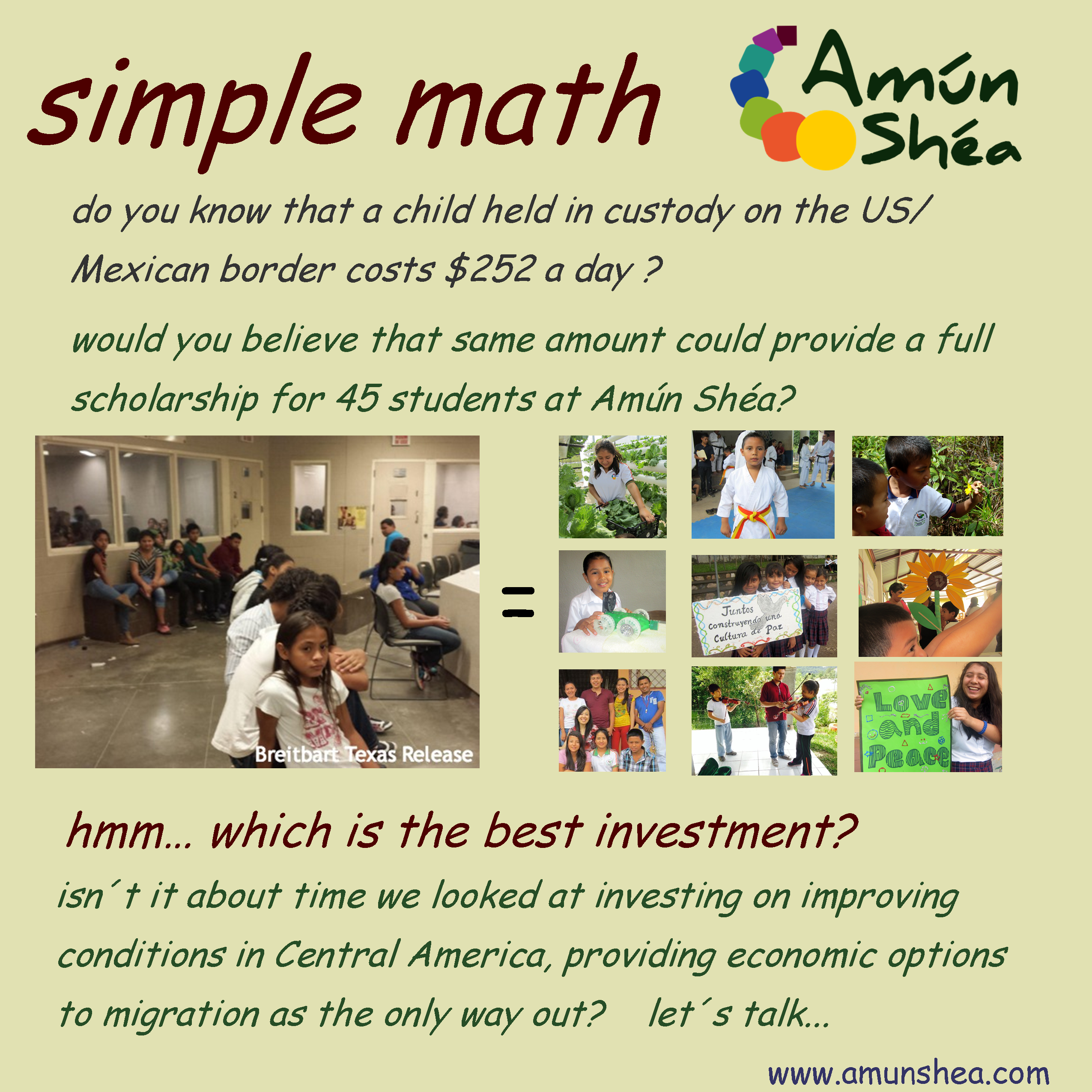
We have been working towards making it worthwhile at the Amún Shéa, Center for Integrated Development in El Salvador. Please consider joining in with support. Let´s do it right this time around.